Find your optimal sleep temperature and learn how humidity, bedding, and airflow affect deeper rest. A comfortable sleep environment supports the body’s natural transition into rest, but the best setting is personal rather than universal.
- A commonly recommended bedroom range is about 60–67°F (15.5–19.5°C).
- Cooler conditions often help the body release heat before sleep.
- Humidity, airflow, bedding, and pajamas can change how a room feels.
- Small, measured thermostat adjustments are more useful than chasing one perfect number.
- Persistent night sweats or overheating deserve attention, especially when they affect daily life.
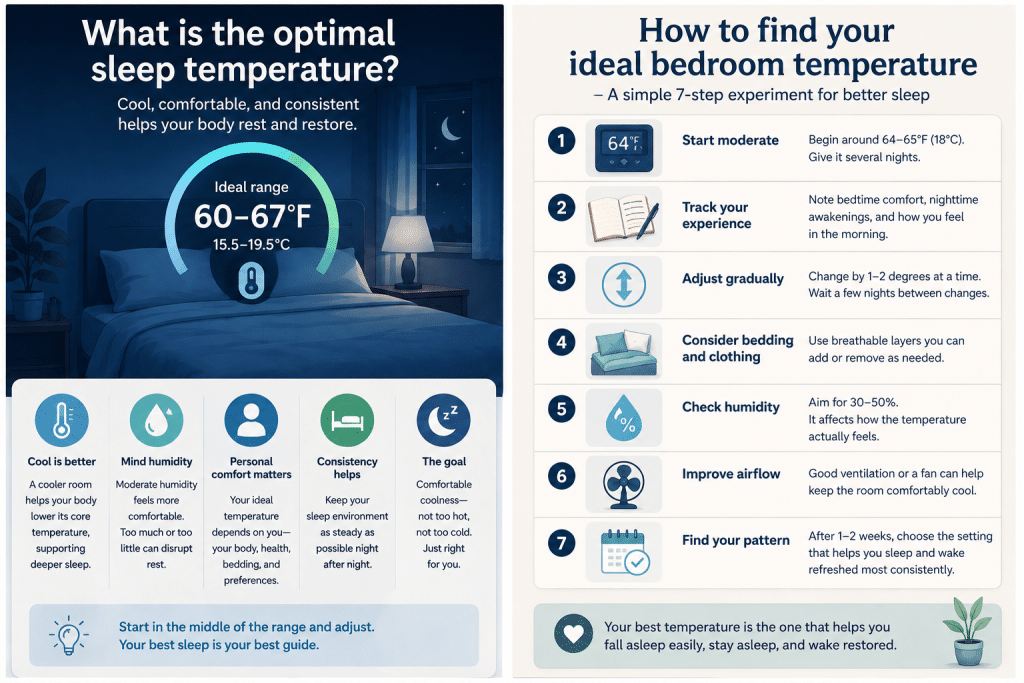
What is the optimal sleep temperature?
The optimal sleep temperature is usually described as a cool bedroom climate, often somewhere between 60 and 67°F. That range is a practical starting point, not a rule that every sleeper must follow. Your age, health, bedding, clothing, humidity level, and personal preference all shape the result. A room that feels pleasantly cool to one person may feel uncomfortably cold to another.
The commonly recommended temperature range
Many sleep specialists suggest beginning with a thermostat setting around 60–67°F, or 15.5–19.5°C. Some recommendations use a narrower band near 60–65°F, while others center on about 65°F. The useful lesson is less about one exact degree and more about avoiding a bedroom that feels stuffy, sweaty, or sharply cold. A recommended sleep temperature range can serve as a sensible experiment rather than a fixed prescription.
Why cooler conditions often support sleep
Core body temperature naturally begins to fall as sleep approaches. A cooler room can make that heat-release process easier, particularly when the alternative is a warm, stagnant bedroom. Excess heat may leave you restless or cause repeated awakenings, while a mildly cool environment often feels more compatible with deeper rest. The goal is comfortable coolness, not shivering.
How humidity changes perceived temperature
Temperature is only one part of the thermal picture. Moist air can make warmth feel heavier because sweat evaporates less efficiently, while very dry air may make a cool room feel harsher on the skin and airways. Two bedrooms set to the same number can therefore produce very different experiences. If the thermostat seems reasonable but sleep still feels uncomfortable, humidity may be the missing variable.
Why individual comfort still matters
There is no single perfect setting for every sleeper. A person who tends to feel warm may sleep better at the lower end of a suggested range, whereas someone with cold sensitivity may need warmer air and lighter, adjustable layers. Couples can compromise with separate blankets, targeted airflow, or a slightly moderate setting. Your own pattern of falling asleep, staying asleep, and waking refreshed is more useful than an idealized number.
How body temperature affects sleep
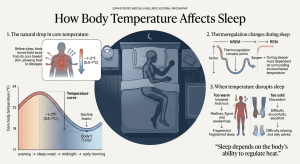
Sleep is an active biological state, not simply a period when the body switches off. Temperature regulation shifts across the night as the brain coordinates sleep stages, blood flow, metabolism, and heat loss. Understanding those changes helps explain why a room can feel fine at bedtime but uncomfortable a few hours later.
The natural drop in core temperature
Before sleep, the body generally moves heat away from its core and toward the skin, where it can dissipate into the surrounding air. This decline in core temperature — roughly 1 to 2°F (about 0.5 to 1°C) across the night, reaching its lowest point in the early morning hours — is part of the preparation for sleep onset. A cool bedroom may support the process, especially when breathable bedding allows warmth to escape. It does not need to feel cold; it simply should not trap more heat than your body can comfortably release.
Thermoregulation during the sleep cycle
Thermoregulation continues throughout the sleep cycle, but the body’s responses are not identical in every stage. During REM sleep — the stage most associated with dreaming — active temperature regulation is largely suspended: responses such as sweating and shivering quiet down, and the body drifts closer to the temperature of the room. That is why the REM-heavy hours later in the night can be especially sensitive to a bedroom that is too warm or too cold. Research on temperature and sleep offers a deeper look at how environmental heat and cold interact with sleep patterns.
How overheating can disrupt rest
A hot or humid room can interfere with the body’s ability to shed heat. You may toss off the covers, shift position, wake thirsty, or move repeatedly between lighter and deeper sleep. These small interruptions are easy to overlook in the morning, yet they can leave sleep feeling fragmented. Thermal comfort protects continuity, which is often as important as falling asleep quickly.
Why cold hands and feet may also interfere with sleep
Being too cold can be disruptive in a different way. The warming of the hands and feet is part of how the body releases heat and settles toward sleep, so cold extremities may make it harder to relax — particularly when the rest of the body is comfortable but the hands and feet remain chilled. Warm socks, a light extra layer, or briefly warming the feet before bed can help without raising the entire room temperature. The best approach keeps the air moderate while addressing the specific area that feels cold.
How to find your ideal bedroom temperature
Finding your personal setting works better as a short experiment than as a one-night judgment. Start with the room, then consider what is touching your skin and how the temperature changes after midnight. Keep the process simple enough to repeat, because a useful pattern usually emerges over several nights rather than from a single restless evening.
Start with a moderate thermostat setting
Begin near the middle of the commonly recommended range, perhaps around 64–65°F if that is practical for your home. Give yourself several nights to notice whether you fall asleep comfortably and remain asleep. If you share the room, ask whether the other person’s experience differs before making a large change. A moderate starting point gives you room to adjust in either direction.
Track comfort, awakenings, and morning energy
A brief sleep note can reveal connections that memory misses. Record the room setting, bedding, approximate time you went to bed, awakenings, and how alert you felt the next morning. You do not need a complicated sleep diary. The purpose is to compare conditions and identify whether warmth, cold, humidity, or another factor repeatedly appears alongside poor rest.
Adjust temperature in small increments
Change the thermostat by only a few degrees at a time, then observe the result for several nights. Large swings can create new discomfort and make it difficult to tell what actually helped. The personal comfort zone for sleep is often found through gradual adjustments rather than by copying another person’s setting. If you wake cold, raise the temperature slightly or add a layer before turning the room noticeably warmer.
Account for bedding, pajamas, and mattress materials
The thermostat does not describe the whole microclimate around your body. Thick blankets, close-fitting sleepwear, and heat-retaining mattress materials can make a cool room feel warm. Conversely, lightweight bedding may leave you cold even when the room seems mild. Use this quick check before changing the air temperature:
- Are your sheets and pajamas allowing heat and moisture to escape?
- Does your blanket hold more warmth than you need after falling asleep?
- Does the mattress feel warmer as the night progresses?
- Would a separate blanket solve a shared-room temperature mismatch?
After this check, adjust the layer that is causing the problem when possible. A lighter blanket may be a more precise solution than cooling the entire bedroom and leaving someone else uncomfortable.
How to maintain comfortable temperatures year-round
Outdoor conditions change, and indoor rooms often respond unevenly to those changes. Sun-exposed bedrooms may remain warm after sunset, while poorly insulated spaces can become cold before morning. Seasonal comfort comes from combining thermostat control with timing, airflow, shading, and flexible bedding.
Preparing the bedroom for hot summer nights
Close blinds or curtains before the room heats up, and ventilate when outdoor air is cooler than indoor air. Lightweight sheets and loose sleepwear can reduce heat trapped against the skin. A cool shower before bed may also help you feel more comfortable, while a fan can move air across the body and support evaporation. These simple measures — shading, timed ventilation, breathable bedding, and airflow — can make a meaningful difference on hot nights when air conditioning is limited.
Staying warm without overheating in winter
Winter comfort does not require turning the bedroom into a warm living room. Use adjustable layers, warm socks if your feet are cold, and a breathable blanket that can be folded back easily. Drafts around windows and doors may matter more than the thermostat reading. Keeping the air moderately cool while warming the bed locally often supports a steadier temperature through the night.
Managing temperature during seasonal transitions
Spring and fall can bring large changes between bedtime and dawn. A setting that feels comfortable at 10 p.m. may be too warm or too cool by 4 a.m. Prepare for that range with removable layers, a timer or schedule on the thermostat, and bedding that can be changed without rebuilding the whole bed. Seasonal transitions are a good time to review your sleep notes rather than rely on last season’s routine.
Using ventilation, fans, and air conditioning effectively
Ventilation can remove stale, humid air, while fans create a cooling sensation without necessarily lowering the room temperature. Point a fan across the room or toward a wall if direct airflow feels irritating, and keep air conditioning filters maintained according to the manufacturer’s instructions. The most comfortable setup is usually quiet and steady rather than a powerful blast that leaves you chilled.
How humidity, airflow, and bedding affect sleep temperature
A bedroom’s felt temperature is shaped by the small environment around the sleeper. Air movement changes evaporation, humidity changes how heat leaves the skin, and bedding determines how much warmth remains close to the body. These factors explain why changing a blanket or fan position can sometimes work better than changing the thermostat.
Choosing breathable sheets and sleepwear
Natural and moisture-managing fabrics can feel more comfortable when you tend to sleep warm, though the weave and weight matter as much as the fiber. Choose loose sleepwear and sheets that do not trap excessive heat around the torso. If you wake damp, focus first on the materials touching your body. If you wake chilled, add a thin layer rather than replacing all your bedding with a heavy comforter.
Managing humidity for greater comfort
High humidity can make moderate warmth feel oppressive, while very low humidity may leave the nose, throat, or skin uncomfortable. A general comfort target is roughly 30–50% relative humidity. A basic room hygrometer can help you see whether the air is changing substantially overnight. Use ventilation or appropriate home humidity control when needed, and avoid assuming that a lower thermostat will solve a moisture problem. Temperature and humidity should be considered together.
Using fans without creating excessive chill
Fans are useful because moving air can improve comfort and help sweat evaporate. However, direct airflow may dry the eyes, disturb sensitive sleepers, or make exposed hands and feet feel cold. Try a lower speed, indirect positioning, or a timer. The point is to create gentle circulation, not to turn the bed into a wind tunnel.
Selecting mattresses and blankets that regulate heat
Mattresses and blankets influence how quickly heat accumulates around the body. Dense layers may feel cozy at bedtime but become uncomfortable later, while breathable construction can make the same room feel cooler. Consider the complete sleep surface, including a mattress protector and sheets. The most useful choice is the one that keeps temperature reasonably stable without requiring constant repositioning.
When sleep temperature needs special consideration
Temperature advice should be adapted when physiology, age, medication, or symptoms change the usual picture. Comfort is still relevant, but safety may matter more than achieving a particular number. When a thermal problem is new, severe, or paired with other symptoms, treat it as information worth discussing rather than simply adjusting the thermostat again.
Temperature preferences during pregnancy
Pregnancy can change thermal comfort through hormonal shifts, changes in circulation, and sleep-position needs. A pregnant person may prefer a cooler room but still need comfortable layers that can be removed easily. Avoid overheating, stay hydrated, and follow guidance from a prenatal clinician when symptoms are unusual or persistent. Individual comfort can change from one trimester to the next.
Helping babies and older adults sleep safely
Babies and older adults may have more difficulty regulating body temperature or communicating discomfort. For infants, overheating is a recognized risk factor for sudden infant death syndrome (SIDS); follow current safe-sleep guidance from a pediatric professional, avoid heavy blankets and excess layers, and dress a baby in no more than one layer more than a comfortable adult would wear rather than aiming for a specific thermostat number. Older adults may benefit from easily adjustable layers and a room free of drafts. Safety and supervision take priority over applying an adult temperature target to everyone.
Managing night sweats and hot flashes
Night sweats and hot flashes can make even a well-controlled bedroom feel unbearable. Lightweight layers, breathable bedding, a cool drink nearby, and gentle airflow may reduce the disruption. Track when episodes occur and whether they relate to medications, menstrual or reproductive changes, alcohol, illness, or stress. A cooler room may help, but it may not address the underlying trigger.
When persistent overheating may require medical advice
Occasional warmth is common, particularly during seasonal changes or after an unusually active day. Repeated drenching night sweats, unexplained overheating, fever, weight change, racing heart, or major sleep disruption deserve medical attention. Seek prompt care for severe symptoms or signs of acute illness. A clinician can consider health conditions, medications, and hormonal factors that bedroom adjustments cannot resolve.
Conclusion
The best bedroom climate is cool enough to support the body’s natural heat loss, yet comfortable enough that you do not wake cold or tense. Begin with a moderate setting, observe your sleep across several nights, and adjust the thermostat, bedding, airflow, or humidity in small steps. That practical process can reveal your personal optimal sleep temperature while giving you a clearer understanding of how sleep physiology shapes the night.
Frequently Asked Questions
What temperature is best for sleeping? A commonly recommended starting range is about 60–67°F, or 15.5–19.5°C. The right setting varies with personal comfort, bedding, humidity, age, and health.
Is it better to sleep in a cold room? A mildly cool room often supports the body’s natural decline in core temperature, but a room that feels cold enough to cause tension or shivering can also disturb sleep.
Why do I feel hot at night even when the room is cool? Bedding, pajamas, mattress materials, humidity, medications, hormonal changes, illness, and stress can all contribute to nighttime warmth. The thermostat may not be the only factor.
Can a fan help me sleep better? A fan can improve air movement and create a cooling sensation. Use a low or indirect setting if direct airflow feels too cold, dry, or noisy.
Should I change my bedding before lowering the thermostat? Often, yes. If heavy bedding or sleepwear is trapping heat, changing those layers may solve the problem more precisely than cooling the entire room.
How can couples with different temperature preferences sleep comfortably? Try separate blankets, breathable individual layers, indirect airflow, or a moderate shared thermostat setting. Local adjustments are often easier than forcing both sleepers into the same bedding.
When should night overheating be discussed with a doctor? Seek medical advice when overheating or night sweats are persistent, severe, unexplained, or accompanied by symptoms such as fever, weight change, palpitations, or significant daytime fatigue.